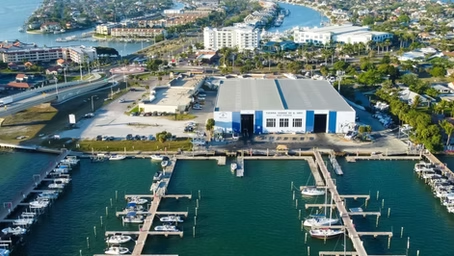
The noise study Greenleaf Capital submitted in its petition for approval of the marina expansion did not address the most important issues of high decibel noise created by the forklifts. It did not take into account the well-known amplification of these high decibel noises by the open rack towers and basic wind.
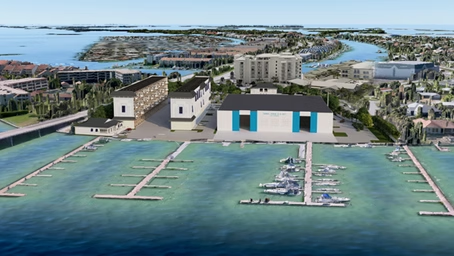
This project would be disastrous for the residents who will have to live with constant noise from forklifts moving boats throughout an unenclosed facility. Greenleaf’s proposed open garage towers are the cheapest possible form of industrial boat storage—one that will subject surrounding neighborhoods to intolerable, continuous, and clearly unlawful noise levels.
There is no version of the proposed open-storage rack towers that avoids the excessive, legally impermissible noise inherent in its design.
How Loud Could It Be?
The operation of large forklifts, which are required to lift and store boats in towers up to 90 feet high, is extraordinarily loud.
According to statements from a major forklift company: “Forklifts of this size typically hit 105–112 decibels. Electric models lean lower, around 80 dB during forward operation, but reach the same 105–112 dB during lifting or when backing up. Engine hum, hydraulic whirs, tire screeches, backup alarms, and load clatter all contribute. These levels routinely exceed safe zones at the source.”
For context, noise above 100 dB is comparable to a chainsaw or a motorcycle at full throttle. The noise from these industrial forklifts is typically audible for up to one kilometer (0.6 miles) under normal conditions—and this proposal sits within one kilometer of hundreds of homes.
Local Noise Ordinances
Both St. Petersburg and Pinellas County have ordinances that clearly prohibit noise of this magnitude.
St. Petersburg Code: Noise “plainly audible” from residences at 500 feet during the day or 200 feet at night is prohibited. While marinas are subject to an exclusion in St. Petersburg, it is clear that the city never anticipated a developer putting such an industrial sized, open-rack facility directly next to houses. Pinellas County Code: Maximum noise levels are 72 dB from 9 a.m. to 10 p.m., and 55 dB from 11 p.m. to 7 a.m. Greenleaf will absolutely be in violation of this code.
As the noise will be amplified by the 72-foot garage towers, the noise will easily travel far beyond these marks. The marina will be in constant violation of any reasonable limits. Forklifts producing 105–112 dB exceed these limits by orders of magnitude, even before amplification effects are considered.
TV Next understands that the developer plans to enclose three sides of the towers to “reduce” noise. This mitigation is unacceptable and unlikely to reduce noise by any discernable amount.
Amplification Due to the “Street Canyon Effect”
The proposed 72-foot-tall open storage towers will create what acoustical engineers refer to as the “street canyon effect.” Just as tall buildings channel and intensify wind, they also trap and reflect sound waves, amplifying noise significantly.
Instead of dissipating, the sound from these forklifts will reverberate between the tall tower walls, creating a continuous echo that magnifies the effective decibel levels far beyond open-air readings. We are prepared to provide technical documentation and studies demonstrating how sound reverberation in confined vertical corridors can amplify decibel levels by as much as 6–10 dB—enough to make an already harmful sound intolerable to nearby residents.
Amplification Due to Wind
It is well known how much wind transports sound. As the marina and all of the homes around the marina are on or next to the water, the number of homes affected increases significantly at these decibel levels.
Again, by allowing the use of unenclosed boat storage, the cheapest storage possible, high decibel noise will travel in an unacceptable manner throughout the neighborhood directly next to the marina.
Constant Operation and Community Impact
The developer’s plan involves daily operation between 8 a.m. and 5 p.m., seven days a week, year-round. During this time, forklifts will constantly lift and move boats, backing up repeatedly—each movement triggering high-decibel backup alarms that cannot be muted or reduced under OSHA safety regulations.
This means the surrounding neighborhoods will experience:
-
Constant beeping and engine noise throughout the day;
-
Elevated ambient noise levels that disrupt conversation, outdoor activities, and peace of mind;
-
Potential long-term hearing risks for those closest to the facility; and
-
Substantial negative impacts on property values and community livability.
Greenleaf Capital’s Claim of “Quieter” Equipment
It is anticipated that Greenleaf Capital will claim they intend to use quieter or electric forklifts. However, this argument does not withstand technical scrutiny.
To lift boats to a height above 50 feet, only the largest industrial-grade forklifts are capable of the required reach and load capacity.
Even if powered electrically, these machines still produce operational noise in the upper decibel range and, critically, are still required by OSHA to use high-volume backup alarms for safety compliance. Despite Greenleaf’s claims, this project as proposed cannot reasonably avoid noise impact on nearby residents.