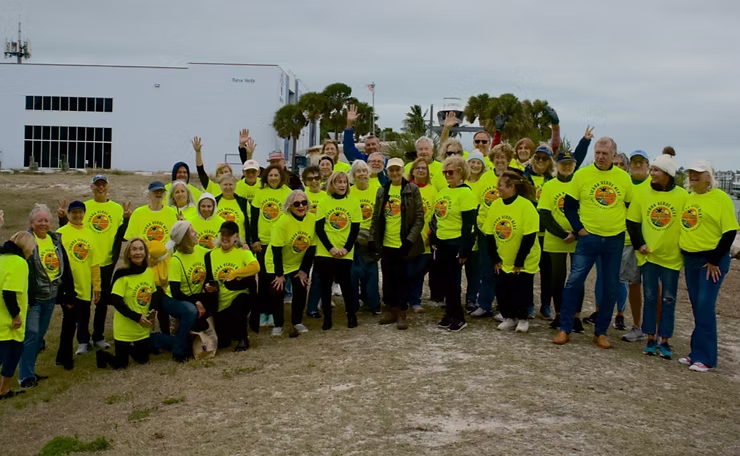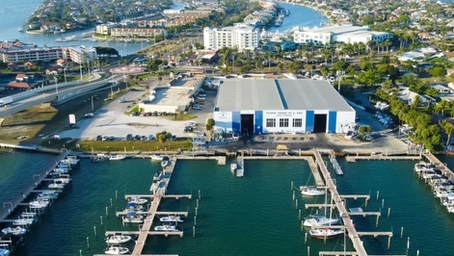
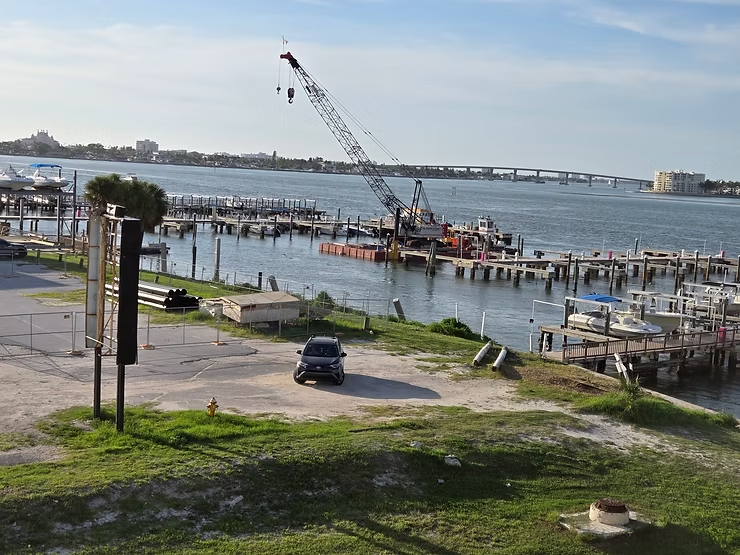
Tierra Verde NEXT is demanding that the St. Petersburg Development Review Commission reopen and rescind its approval of Greenleaf Capital’s planned Tierra Verde Marina expansion after the Florida Department of Environmental Protection confirmed that a State Submerged Lands Lease requirement invalidates Greenleaf’s method of meeting its mandatory number of parking spaces.
A developer is required by code to provide a minimum number of parking spaces. Greenleaf was required to provide 226 spaces, after asking for—and receiving—a 40 space reduction because its buildings will be close to the Pinellas Trail. To meet this new total, Greenleaf argued in writing and under oath that 29 wet slips would be dedicated to patrons arriving by boat instead of by car, thereby eliminating the need for 29 parking spaces and reducing the required total parking to 197 spaces.
However, Greenleaf never had the lawful authority to commit those 29 slips. Under the company’s Sovereign Submerged Lands Lease No. 520265869, at least 90 percent of the marina’s wet slips must remain available for rent to the general public on a first-come, first-served basis. Greenleaf claims it has 89 wet slips; therefore only nine, not 29, can be reserved. All other slips must remain available to the public at large. They cannot be exchanged for parking.
The Submerged Lands Lease is not an obscure contract. It is legal permission for the company to use Florida’s water to conduct its business. It underlies all other codes.
Greenleaf invoked these illegitimate credits because without them, it could not meet the required number of mandatory parking spaces.
Greenleaf is currently under investigation by the state for substantial violations of its Submerged Lands Lease. Most of its slips are used by two boat clubs, a boat rental company and the Tampa Bay Pilot Boats Association instead of being available to the general public. Current and past violations do not justify violations in the future.
GREENLEAF’S ATTORNEY INCORRECTLY RELIED ON THE STATE LEASE
At the May 6, 2026, DRC hearing, Greenleaf attorney Nicole MacInnes expressly invoked the State Submerged Lands lease while explaining the parking reduction.
MacInnes said, “So, there are 89 wet slips that are allowed per the sovereign submerged land lease. Twenty-nine of those we allotted for the parking reduction. That is for the ability to pull your boat up to then go to a use on the property.”
DRC Chairman Kevin Reali asked whether the 29 slips were “excluded from leasing.” Attorney MacInnes confirmed that they were, and City staff stated on record that the exclusion was enforceable. The DRC then awarded Greenleaf the 29 parking credits.
THE CITY SAYS THE LEASE IS IMMATERIAL
The City of St Petersburg has, for now, rejected reopening the approval process, saying the terms of the lease are “immaterial.” Tierra Verde Next contends that this position is factually incorrect and legally indefensible.
The City cannot reasonably rely on Greenleaf’s submerged-land lease as material evidence that Greenleaf was entitled to 89 wet slips when awarding the 29 parking credits, then declare that same lease “immaterial” when its public-rental requirement prevents Greenleaf from lawfully reserving those slips for exclusive restaurant and pool use. The City cannot use the lease when it benefits Greenleaf and disregard it when it undermines the very representation on which the approval depended.
A possible future lease modification that has not been requested, and might never happen, does not cure what existed at the time of the DRC hearing.
Greenleaf had no demonstrated legal authority under its existing State lease to make the 29-slip commitment when the project was approved.
“The City’s apparent position is to let Greenleaf obtain the approval first and possibly correct the legal authority later,” said Geoff Comrie, a member of Tierra Verde Next’s steering committee. “That turns the required approval process backwards. A quasi-judicial decision must be supported by lawful facts and authority at the time the decision is made—not by approvals an applicant might obtain sometime afterward,” Comrie said.
DID THE CITY VERIFY GREENLEAF’S STATE LEASE?
In a review of over 1,000 pages of the DRC record and staff report, there are numerous references to the lease by Greenleaf and the DRC, but the actual eight-page document is absent. It was never submitted to staff for consideration.
“That is not a minor administrative oversight. It goes directly to the factual and legal foundation of the approval,” Comrie said.
WITHOUT PARKING CREDITS, THE ENTIRE PROJECT FAILS
Without the additional parking credit for wet slips, Greenleaf cannot meet its code requirement for parking spaces. TV Next adamantly opposed the DRC providing bike trail credits to Greenleaf as no customers bike to take their boat on the water for the day.
“Take away the legally unsupported parking credit and the approved plan collapses,” Comrie said.
TV NEXT DEMANDS IMMEDIATE RESCISSION
Tierra Verde NEXT is calling on the City and DRC to:
1. Agree to return Case No. 26-32000001 to the DRC for a noticed reconsideration, modification or rescission proceeding.
2. Immediately suspend reliance on the 29 wet-slip parking credits and halt the processing of any permits dependent upon them.
3. Explain why the operative State lease and Special Lease Condition D were not reviewed before staff represented that the 29-slip restriction was enforceable.
4. Recalculate the project’s parking requirement without the 29 disputed credits.
5. Rescind the approval if Greenleaf cannot legally provide enough parking to avoid impacting the surrounding residential neighborhood.